AI Theater: What a viral Copilot post says about enterprise IT
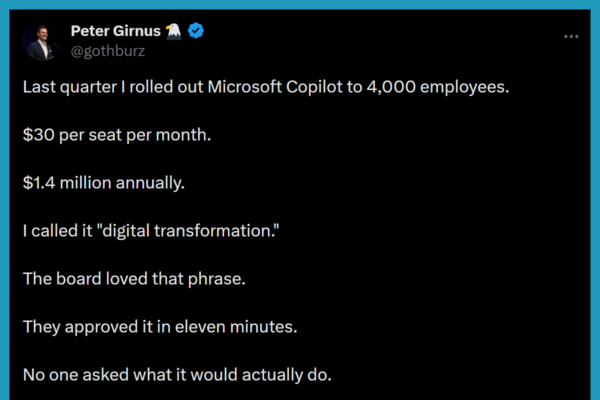
Last week, Peter Girnus, a senior threat researcher from Austin, TX, published a satirical post on X about a failed Microsoft Copilot deployment that seems to have struck a nerve. The post quickly racked up over 21 million views, thousands of shares, bookmarks, and replies from professionals who saw their own experiences reflected back at them.
This tongue-in-cheek confession, written from the perspective of a technology leader, chronicles a $1.4 million annual rollout of Microsoft’s Copilot AI tool to 4,000 employees that resulted in just 1% of users actually opening it. The satirical post pulls no punches, describing how buzzwords like “digital transformation” and “10x productivity” secured board approval in minutes, while actual usage metrics were buried or ignored.
Why AI satire resonates with IT professionals
For many IT pros, the post reads less like a darkly humorous account and more like a documentary. The scenario it describes touches on familiar pain points:
Metrics theater over substance. The post describes creating meaningless measurements, such as “AI enablement,” to satisfy executives who want dashboards that trend upward. IT teams know the difference between vanity metrics and real value, but they’re often pressured to deliver the former.
Top-down mandates without user research. The decision to deploy Copilot was made by leadership without considering whether employees actually needed or would use it. When a developer questioned the choice of tools, he was silenced rather than heard. This disconnect between decision-makers and practitioners is a recurring frustration.
The compliance shield. When challenged on technical decisions, the protagonist retreats to vague claims about “enterprise-grade security” and “compliance.” These phrases can shut down legitimate questions, even when they’re not backed by actual requirements.
Success redefined. The post’s definition of pilot success, “the pilot didn’t visibly fail,” will ring painfully true for anyone who has watched leadership declare victory on projects with abysmally low adoption rates.
The real cost of AI theater
Beyond the obvious waste of $1.4 million, this kind of deployment creates deeper problems. It erodes trust between IT and business units, trains employees to ignore new tools, and makes future technology initiatives harder to execute. When the next genuinely useful tool comes along, why would employees engage with it?
The post also highlights a dangerous trend: organizations making massive AI investments based on FOMO (Fear of Missing Out) rather than strategy. The pressure to be “AI-enabled” leads to rushed decisions where success is measured by spend rather than outcomes.
What IT leaders can learn
While the post is satirical, it offers a blueprint of what not to do. Successful technology adoption requires understanding user needs, measuring meaningful outcomes, and being honest about what works and what doesn’t. It means having the courage to pause or pivot when usage data tells you something isn’t resonating.
The post ends with the storyteller planning to expand from 4,000 unused seats to 9,000, illustrating that in some organizations, the show must go on, regardless of reality. For IT professionals tired of that performance, the post serves as both catharsis and cautionary tale. Its closing line, “The future is whatever I say it is. As long as the graph goes up and to the right,” neatly sums up the performance-driven mindset it skewers.
The responses to this post suggest many IT professionals are ready for a more honest approach to enterprise AI. One where adoption metrics matter more than social networking likes, where modern IT leaders can ask questions without career consequences, and where “investment” means solving actual problems rather than checking boxes on a trends list.
Whether it’s dashboards that trend upward or tools that gather digital dust, every IT pro has a tale to tell. Have you experienced AI rollouts that delivered more hype than value, or those that actually worked? Share your stories and lessons learned in the comments; IT pros would love to hear how your experience compares.