Top 10 Customer Identity Management Solutions in 2021
This article shares the top 10 customer identity management solution recommendations for 2021 and beyond.
Customer identity and access management (CIAM) can be defined as the strategies, processes, and tools used to govern how customers use a website, how their identity or account data is stored and utilized, and how identity data is protected from breach. It refers to the controls adopted for governing how customers access your website, how their data is managed and utilized, and how you protect yourself against a breach. This article lists the top 10 customer identity management solutions to protect your business while generating value from identity data.
Table of Contents:
- What Is Customer Identity Management?
- Key Must-Have Features of a Customer Identity Management Solution
- Top 10 Customer Identity Management Solutions in 2021
What Is Customer Identity Management?
Customer identity and access management (CIAM) can be defined as the strategies, processes, and tools used to govern how customers use a website, how their identity or account data is stored and utilized, and how identity data is protected from breach. It refers to the controls adopted for governing how customers access your website, how their data is managed and utilized, and how you protect yourself against a breach.
Identity and access management is a broad field that deals with user identity verification, access controls, and identity data utilization in an enterprise setting. Customer identity management is a subset of identity and access management, which serves two purposes:
- It increases customer confidence in a brand, reassuring them that the data will not be misused or misplaced. It also offers customers better control over their data. For example, a customer (i.e., the data subject) can choose to have only functional data stored by a website or choose to share behavioral data for more personalized website experiences. That’s how CIAM solutions empower the customer.
- It also benefits the enterprise by allowing it to deliver a more personalized and conversion-friendly website experience. Businesses can maximize the value of identity data as CIAM solutions ensure compliance and minimize any data breach risk.
Consumers are now more conscious about how their data is being used, and 63% hold the business responsible for protecting user data. A staggering 81% of consumers said they wouldn’t engage with a brand online if they witnessed a data breach. In this environment, it is critical to adopt customer identity management solutions that provide personalized experiences without violating customer data privacy or rights.
Also Read: What Is Digital Rights Management? Definition, Best Practices with Examples
Key Must-Have Features of a Customer Identity Management Solution
Given the criticality of customer identity management solutions, you need the right features and capabilities to drive business success. Here are some essential features one should look for in a customer identity management solution:
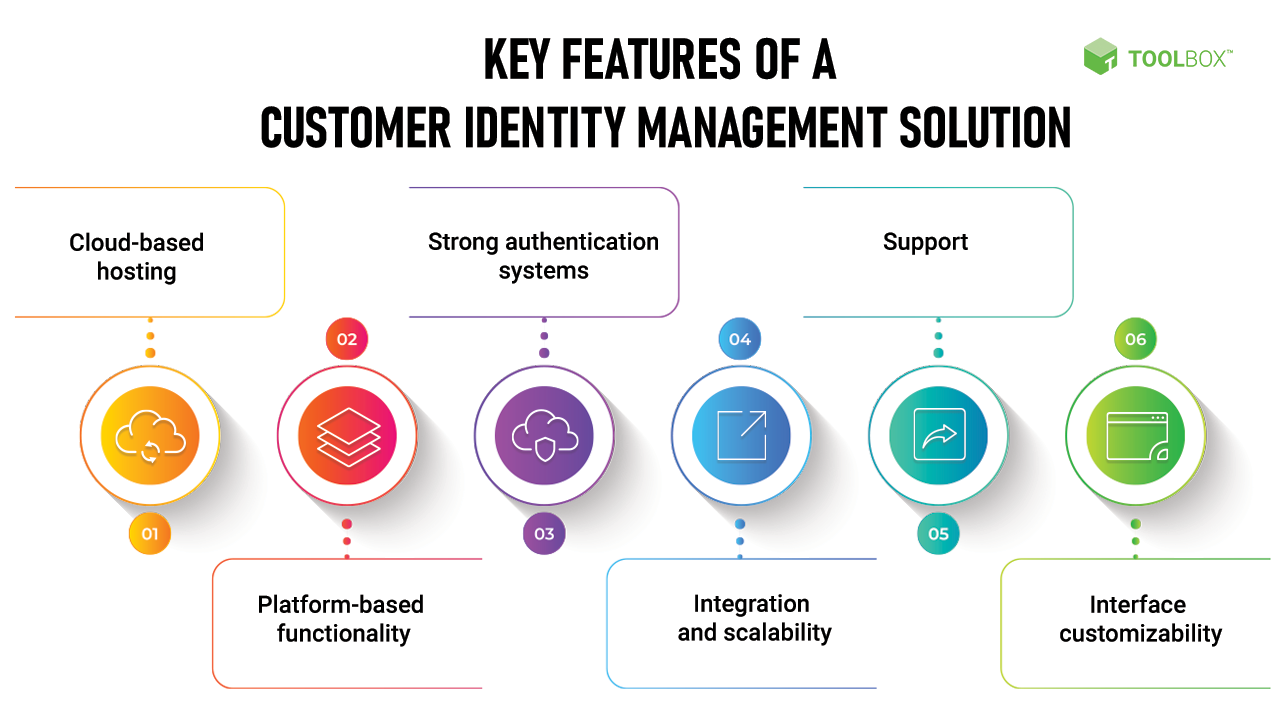
Key Features of a Customer Identity Management Solution
-
Cloud-based hosting
The solution should ideally allow cloud-based hosting so that you can leverage it across different environments and devices. Cloud-based solutions are easier to patch and upgrade, which keeps your customer identity management systems up-to-date. Interestingly, you may also want the option of hosting customer identity data on-premise to comply with industry regulations.
-
Platform-based functionality
A platform requires minimum IT expertise to manage customer identity data and protocols. The platform brings together different features and services under a consolidated user interface that is easy to learn and implement. You’ll find two types of CIAM solutions in the market: services and platforms, of which we’d recommend the latter due to its ease of use and scalability.
-
Strong authentication systems
Authentication is a primary feature for any customer identity management solution, ensuring that customer identity is accurate and verified. This feature detects identity theft and stops malicious bots from attacking a website with fraudulent traffic. Typically, CIAM comes equipped with various authentication protocols like multi-factor authentication (MFA), single sign-on (SSO), etc.
Also Read: Top 8 Digital Rights Management Software in 2021
-
Integration and scalability
A consumer-facing application or website will use hundreds of integrations to conduct business. And this number will only grow as your business scales, and you add new products, services, and customer experience (CX) enhancements. Therefore, your solution must be scalable in two ways:
-
-
- It should adapt to any new app integration you need.
- It should adapt to a fast-growing user volume.
-
-
Support
This key feature is often overlooked when assessing CIAM solutions. Remember, customer identity management is an essential cog for business continuity, without which you’d face downtime. Unplanned downtime or outage can turn off customers for good, so you need reliable vendor support from your CIAM solution provider to resolve issues and keep your website up and running quickly. Useful support capabilities include detailed documentation, well-organized FAQs, self-service, a short email response time, and 24/7 telephonic support.
-
Interface customizability
This feature lets you customize the login interface so that your customers receive a consistent and compelling brand experience. The login interface is feature-rich and ensures strong authentication and appropriate identity data management protocols while also being easy to navigate. You might also want white-label capabilities, where you incorporate a brand’s color palette, logo, and other visual elements to increase recall.
Apart from this, every CIAM provider will have a unique value proposition. Some may let you integrate with your corporate (employee-facing) IAM systems. Others may connect with customer relationship management (CRM) systems to feed data and drive personalization seamlessly.
Many emerging players use technologies like artificial intelligence (AI) to take CIAM to a whole new level.
Also Read: Identity Management Day: Experts Outline Best Practices To Secure Online Identities
Top 10 Customer Identity Management Solutions in 2021
The CIAM market is booming. It is expected to reach $15.3 billion by the year 2025. So how do you find the best solution for your company, one that addresses all your requirements and adds value? To make the decision easier, we scoured the current customer identity management solution marketplace to bring you our top ten recommendations. They are highly rated by users worldwide — here’s a detailed look at the top solutions (arranged alphabetically).
Disclaimer: These listings are based on publicly available information and include vendor websites that sell to mid-to-large enterprises. Readers are advised to conduct their own final research to ensure the best fit for their unique organizational needs.
1. Akamai Identity Cloud
- Overview: This is a cloud-native, customer-specific solution with various customizable options, marketing technology (MarTech) integrations, and built-in analytics.
- Features: Akamai Identity Cloud offers the following features:
- Protocols such as OpenID Connect, social media, attribute-based access, MFA, and SSO.
- Compliance as per GDPR, CCPA, PIPEDA, and other consumer identity data regulations.
- Integrations with CRM, CMS, MarTech, and SIEM tools.
- Flexible deployment through either APIs or SDKs as per your use case.
- Built-in dashboards for customer data analysis.
- Highly customizable in terms of data import/migration, localization, multiple brands, etc.
- Pros: Akamai Identity Cloud serves over 1.5 billion customer identity requirements globally. The CIAM solution is powered by Akamai’s intelligent edge platform for secure digital infrastructure.
- Pricing: Varies based on a company’s scale and user volume.
- Rating: 3.5 out of 5 on G2.
- Meant for: Large brands with a distributed presence who can invest in an expensive but robust customer identity management solution.
- Editorial comments: Integration and scalability are major USPs, as the solution can integrate both with internal IT systems and customer-facing CRM, CMS, etc. However, this solution is cloud-native. Therefore, there is no option to install it on-premise. The tool offers priority support as an additional module (called CIAM Enhanced Support SLA) for extra pricing.
2. Amazon Cognito
- Overview: Amazon Cognito is an easy-to-use customer identity management product powered by AWS. It targets developers who want to address a growing number of users on their platforms.
- Features: Amazon Cognito offers the following features:
- A unified directory for all your applications, governing siloed customers from one solution.
- Built-in, customizable UI for user registration and login.
- Flexible deployment through either Android, iOS, or JavaScript SDKs, with further options to choose Objective C or Swift for IoS.
- Advanced security features, such as risk-based authentication, which can be enabled for different Amazon Cognito user pools.
- Social media sign in through Google, Facebook, or Amazon.
- Compatibility with prominent protocols like OpenID Connect, OAuth 2.0, and SAML 2.0.
- Pros: Adaptive authentication is one of Cognito’s most compelling advantages. It adapts to red flags like sign-in attempts from new locations/devices, assigning a risk score to the activity. The solution also complies with HIPAA, PCI DSS, SOC, ISO/IEC 27001, ISO/IEC 27017, ISO/IEC 27018, and ISO 9001.
- Pricing: After you cross the 50,000 user threshold, Amazon Cognito costs $0.00550 per monthly active user for the next 50,000 users, with tiered pricing after that.
- Rating: 3.9 out of 5 on G2.
- Meant for: Ecommerce stores and online products or service providers in their early stages of growth.
- Editorial comments: Cognitio is free for the first 50,000 users, making it an excellent choice for independent developers and startups. However, Cognito is entirely cloud-based and requires an AWS account.
Also Read: Why Identity Orchestration Remains the Missing Piece in the Access Management Puzzle
3. Azure Active Directory B2C
- Overview: It is a customer and user identity and access solution for B2C apps, powered by Microsoft’s cloud-based identity data directory service.
- Features: Azure Active Directory B2C offers the following features:
- Scalable up to 100s of millions of customers.
- Every single pixel of the login UI and registration page can be customized.
- Integration with apps and databases to maximize customer identity data.
- Application or policy-based MFA for customer data security.
- It is backed by Microsoft’s 3,500+ security experts.
- Pros: Azure is currently the world’s most highly certified cloud vendor in terms of compliance. The solution is also scalable for use by Zeiss, the NBA, and other large customers.
- Pricing: Beyond 50,000, you’ll be charged $0.00325 for every additional user in the Premium P1 addition and $$0.0162 in Premium P2, which includes advanced risk-based policies and reporting. Note that there is a flat fee for every SMS/phone-based MFA event, as well as technical support fees starting at $29.
- Rating: 3.8 out of 5 on G2.
- Meant for: This solution is ideal for fast-growing companies who are already a part of the Microsoft ecosystem as it requires integration with other Microsoft applications.
- Editorial comments: This customer identity management solution is free for up to 50,000 monthly active users. Further, it boasts of incredible white-labeling capabilities and 99.9% uptime. But keep in mind that it is a 100% cloud-based solution and limited only to Azure users.
4. ForgeRock
- Overview: A unified platform for 360-degree identity data management across customers, your workforce, and IoT devices/data streams, hosted on the cloud.
- Features: ForgeRock offers the following features:
- Identity lifecycle management features across the customer journey.
- Built-in workflow engine that lets you quickly create user requests, approval, account creation, updates, and deletion workflows using the industry-leading BPMN 2.0 standard.
- AI to manage access and identity data intelligently.
- Follows zero-trust and the Gartner Continuous Adaptive Risk and Trust Assessment (CARTA) strategies.
- Supports passwordless registration for a seamless CX.
- Can be implemented on-premise, in the cloud, or in containers.
- Pros: ForgeRock has progressive profiling, which lets you slowly obtain user identity data for CX personalization over time and reduce the initial registration process.
- Pricing: Varies based on a company’s scale and user volume.
- Rating: 4.4 out of 5 on G2.
- Meant for: ForgeRock is meant for companies looking for mixed environment implementation, with plans for expanding into consumer interactions on IoT devices.
- Editorial comments: This is among the few customer identity management solutions available for IoT devices. Also, it is backed by a massive library of integrations and partnerships. But as a relatively new provider (founded in 2010), it lacks a large community, which is probably why a handful of users complain about the lack of support.
Also Read: What Is Multi-Factor Authentication? Definition, Key Components, and Best Practices
5. Google Cloud Identity Platform
- Overview: The Google Cloud Identity Platform is a CIAM platform powered by Google Cloud and Google’s industry-leading AI capabilities, with a transparent and predictable pricing model.
- Features: Google Cloud Identity Platform offers the following features:
- “Google-grade” identity authentication capabilities on both mobile and web.
- Multi-factor authentication, with SAML, OpenID Connect, and phone/SMS protocols.
- Transparent SLAs with downtime costs credited to your bills.
- Supports different brands, business units, and other types of user silos in a single solution instance.
- It can be implemented through app SDKs (Android, iOS, and web) as well as admin SDKs (Node.js, Java, Python, etc.)
- Pros: The pricing and SLA transparency makes Google Cloud Identity Platform stand out with dedicated billing components for different authentication mechanisms. You also get $300 in free credits when getting started.
- Pricing: Free up to 49,999 active monthly active users and $0.0055 for the 50,000 new users — the pricing per user reduces as you scale. Keep in mind that there are additional fees for telephonic authentication instances.
- Rating: 4.5 out of 5 on G2.
- Meant for: It is ideal for independent developers and small businesses already using the Google Cloud Platform. It is also good for companies looking to gain from Google’s intelligent customer identity management capabilities.
- Editorial comments: The solution cannot be implemented as a standalone tool. You need to subscribe to all Google Cloud Platform products (90-day free trial) to get the Identity Platform. But this could be a substantial investment, as Google is known for its secure and seamless login experience, as well as its AI technology.
6. LoginRadius
- Overview: It is a developer-focused customer digital identity solution that lets you integrate strong authentication and SSO capabilities with a single code snippet.
- Features: LoginRadius offers the following features:
- Authentication via MFA, social credentials, or standard user name/email mechanisms.
- Web and mobile SSO, also acting as a federated SSO for third-party apps.
- Cloud-based directory service for customer profiling and progressive profiling.
- GDPR and privacy-focused customer data governance and consent management.
- Customer segmentation insights and profile management.
- Integration with 150+ applications on the cloud.
- Pros: Supports a variety of implementations through PHP, NodeJS, DOT NET, JAVA, Android, IoS, and JS.
- Pricing: LoginRadius is available in three versions: free forever up to 5,000 monthly active users with limited features, $14 per month for up to 1,000 monthly active users, $144 per month for up to 1,000 monthly active users, and an enterprise edition with custom pricing.
- Rating: 4.5 out of 5 on G2.
- Meant for: It works best for independent developers looking for a fast and simple solution that they can quickly integrate and gradually scale to more robust and expensive features.
- Editorial comments: LoginRadius has an ever-growing list of integrations with your favorite cloud-based apps like Salesforce, HubSpot, Drupal, SendGrid, MailChimp, ZenDesk, etc. On the flip side, it’s quite technical and requires a level of prior knowledge to implement effectively. LoginRadius may not be suited for first-time business users in small companies.
Also Read: What Is Biometric Authentication? Definition, Benefits, and Tools
7. Omada CIAM
- Overview: Omada CIAM is a customer identity management solution that aims to provide the same level of security and asset governance to external identities as you adopt for internal IAM.
- Features: Omada CIAM offers the following features:
- Customer identity management across the lifecycle from joining to updates to account deletion.
- Unified customer view for better understanding.
- Faster customer onboarding through self-service and SSO.
- Available in cloud-based or on-premise versions with feature parity.
- Compliance with all leading customer data management regulations.
- Customer empowerment by letting them control their profiles.
- Pros: It is powered by Omada Identity, an enterprise identity management technology that balances rich features with minimal custom development.
- Pricing: Varies based on a company’s scale and user volume.
- Rating: 3.8 out of 5 on G2.
- Meant for: It works best for legacy enterprises or those undergoing digital transformation. They can gain from Omada CIAm’s ability to sit on-premise until you’re ready to switch to the cloud.
- Editorial comments: Customers note that the initial setup process is lengthy, and the UI/UX has a difficult learning curve. But this is among the few CIAM solutions available both on-premise and on the cloud, that too with feature parity.
8. OneLogin Trusted Experience Platform
- Overview: It is a CIAM solution powered by a globally leading SSO provider, available both as an end-to-end platform and developer APIs.
- Features: OneLogin Trusted Experience Platform offers the following features:
- A cloud directory to manage and govern customer identity data.
- Authentication via policy-based MFA and API-enabled workflows.
- Assisted migration from existing IAM to support a modernized digital footprint.
- An impressive library of developer APIs, with 99.9% uptime.
- Smart factor authentication and social login for a seamless customer experience.
- SSO coverage for both product catalog and customer support.
- AI-powered, context-aware security to detect high-risk customer activities.
- Pros: OneLogin is pre-integrated with 6,000+ apps (and growing), making it suitable for various use cases.
- Pricing: OneLogin has several customer identity management products (like Customer Identity Foundations, CE SSO, CE Access, CE Identity Lifecycle Management, etc.) that can be implemented together or on a standalone basis — pricing varies based on your requirements.
- Rating: 4.3 out of 5 on G2.
- Meant for: Companies looking to address a specific customer identity use case and want to invest in a cost-optimized point solution.
- Editorial comments: Several customers have reported the lack of flexibility from a developer’s perspective and weak consent management capabilities, which could be something to watch out for. The solution’s USP is its AI-powered SmartFactor authentication that assesses a login attempt in real-time, defines risk thresholds, adjusts the authentication requirements, and alerts you against high-risk activities that may need to be blocked.
Also Read: Top 11 Facial Recognition Software in 2021
9. Ping Intelligent Identity Platform
- Overview: A standards-based platform that allows customers to access your services, applications securely, and APIs, covering a hybrid IT environment.
- Features: Ping Intelligent Identity Platform offers the following features:
- Interoperable and extensible across the Google apps marketplace, Salesforce Office 365, and other web applications.
- AI capabilities to analyze customer behavior and detect anomalies.
- Custom policies for authenticating user identity based on business rules.
- Consolidation of customer data from multiple sources in a secure manner.
- A centralized admin portal called Ping Central to quickly provision identity management services.
- Pros: Can be deployed on the public or private cloud or as an installable software license for on-premise usage and greater control.
- Pricing: Varies based on a company’s scale and user volume.
- Rating: 4.4 out of 5 on G2.
- Meant for: It works best for companies with a hybrid IT environment without locking into a single cloud vendor like Microsoft, Google, or AWS, looking to scale and diversify.
- Editorial comments: Ping is known to be relatively expensive and needs technical expertise to customize its open standards effectively. One of its most significant advantages is that the solution can be implemented as a one-stop solution called Customer360. Or, you could deploy it as standalone solutions for identity management, consent management, multichannel profile management, risk management, and MFA.
10. SAP Customer Identity and Access Management Solutions for B2C
- Overview: This is a CIAM solution based on the SAP Customer Data Cloud that helps marketers leverage first-party data for a better CX and higher conversion across channels.
- Features: SAP Customer Identity and Access Management solutions for B2C offers the following features:
- UI builder to create custom self-registration pages.
- Social login for 35+ social networks.
- Security and compliance support for customer identity on IoT devices.
- Progressive profiling to understand the customer over time.
- Global access for customers using a single account.
- SSO, identity federation, and standards-based access management.
- Monitoring of digital identities by cross-checking with two billion+ instances worldwide.
- Pros: SAP is known for its customer experience solutions, and CIAM for B2C can help convert customer identity data into personalization at scale.
- Pricing: Varies based on a company’s scale and user volume — price upon request.
- Rating: 3.5 out of 5 on G2.
- Meant for: It works best for companies with existing dependencies on SAP for CX management or those with a detailed marketing personalization roadmap.
- Editorial comments: It can be complex to set up and configure. But you may gain from Gigya’s proprietary customer data and identity technology that was acquired by SAP in 2017, as well as from SAP’s global scale.
As you can see, customer identity and access management is not just about security or compliance. It has the potential to add ongoing value by contributing to your marketing strategies, improving your targeting capabilities, and maintaining business continuity for an online business. By choosing the best customer identity management solutions for your company, you can achieve these benefits and more.
Which parameters do you look at when assessing customer identity management solutions? Comment below or let us know on Facebook, LinkedIn, and Twitter. We would love to hear from you!