Ineffective Leadership Is the Top Reason Leaders Want To Quit
Where should companies focus to deliver the growth leaders crave?

As businesses go through several trends, leaders are expected to lead from the front. But are leaders doing enough? Moreover, is what they are doing sufficient to fulfill them personally? DDI conducted a study to understand where leaders are stalled and frustrated and where companies should focus to deliver the growth leaders crave.
The business world has seen several trends over the last few years. However, one thing that seems certain in the near future is uncertainty, given that businesses have witnessed a roller coaster ride over the previous three years. In such a situation, are leaders doing enough to engage, inspire, and prepare their workforce for these uncertainties? Moreover, is what they are doing at work enough to fulfill them personally, given other priorities in their lives?
After leading through the past few years of challenges, the leadership pipeline seems to be showing signs of exhaustion and restlessness. They also seem to be seeking more from their employers and work. Further, they may be considering workplaces and careers that complement the life they want and where trust runs fluently across leadership ranks. Above all, they, too, seek growth.
Development Dimensions International (DDI) recently conducted a study to understand where leaders are stalled and frustrated, the opportunities where leaders can be engaged and developed, and how to invest in the right development opportunities that deliver the growth leaders crave. The following are insights and recommendations to fuel a leadership growth strategy.
Retaining and Developing Future Leaders Are CEOs’ Top Concerns
Given the constant changes in the workforce landscape, CEOs know their workforce’s fragility. As such, talent-related challenges are the ones keeping most CEOs up at night. Some of these challenges are attracting and retaining top talent (59%), developing the next-gen leaders (50%), and maintaining an engaged workforce (45%). Beyond talent challenges, digital transformation (40%), global recession (37%), and driving new product innovation (36%) are other top challenges for CEOs.
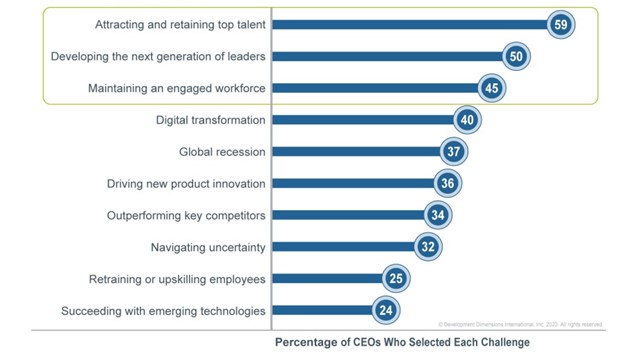
Top CEO Concerns
Source: Global Leadership Forecast 2023
Where employers should focus
Given trends like the Great Resignation and quick quitting, talent retention is undoubtedly a top concern for CEOs. That said, as employee expectations change, companies should embrace changes to their work culture and policies to attract and retain top talent and leaders. According to the study, among the factors influencing retention, ineffective leadership is the top reason leaders want to quit within the year. When leadership was considered to have ineffective interpersonal skills, leaders were 3.5x more likely to quit within the year.
Hence, CEOs worried about talent retention should evaluate their leadership culture. They should consider how to set the tone and develop leaders who lead from a holistic, human-centered approach, incorporating practical and personal needs of work.
See more: 61% Senior Leaders Spend One-third of Their Day Solving Employee Churn Problem
Companies Building Bench Strength Gain Big Rewards
A major trend, according to DDI’s previous studies, is the shortage of leaders to fill critical roles. Due to talent shortage over the last three years, organizations have struggled to rebuild their talent pools, and there is a significant shortage of leaders prepared to fill key leadership roles. Just about 12% of organizations display confidence in their bench’s strength, and they are reaping significant benefits. For example, compared to companies with weak benches, they are 6x more likely to be capable of engaging and retaining talent.
Companies with a strong bench invest heavily in identifying and developing high-potential talent with various capabilities. This enables companies to be more agile in meeting challenges.
Where employers should focus
In a tight talent market, organizations should find leadership internally, which has become difficult as benches have become leaner. HR respondents agree about the challenge, and 33% said there would be a significant increase in the need to develop internal talent. To see long-term success, businesses should be thoughtful about finding and developing potential leaders internally. Here is how they can do it:
- Plan for a stronger and more diverse future pipeline.
- Surface potential earlier and more broadly.
- Develop leaders’ virtual capabilities to build talent.
- Create dynamic success profiles for critical roles.
Confidence in Leadership Takes a Hit
In the early 2020s, when the COVID-19 pandemic hit the world, there was a spike in confidence in leadership quality as employees trusted their leaders to guide them. But now, exhaustion and cynicism have set in. Only about 40% of leaders report their organizations having high-quality leaders. While leaders struggle to maintain the trust and confidence of their teams, they face internal challenges. About 72% of leaders report feeling used up, an increase from 60% in 2020. Further, leaders are worried about their teams’ burnout. And as leadership exhaustion sets in, employee expectations are going up.
Where employers should focus
Leadership quality ratings are closely intertwined with company culture. Hence, employers should focus on creating a high-quality leadership culture. Among the companies with high-quality rankings for leaders, the following strategies are in place:
- They develop leaders in critical leadership skills.
- They employ people-centric talent practices focused on the development and career growth.
- They implement a common leadership strategy and model across the company.
- They offer high-quality development across the entire leadership pipeline.
- They focus on promoting leaders internally than hiring external ones.
Companies succeeding with these practices have an average of 42% higher quality leaders than their peers.
Hybrid Work Isn’t Delivering on Its Promise
As companies were concerned with productivity and collaboration and employees were concerned with flexibility, companies implemented the hybrid model to bring the best of both the in-house and remote working models. However, only about 49% of leaders working in a hybrid role are definitely engaged. Further, only about a third say that their work energizes them, almost 10% less than their in-person and remote counterparts. This may be because hybrid work is combining the worst of both worlds instead of the best.
Where employers should focus
For remote and hybrid models to succeed, employees must be engaged. Four leadership behaviors stand out in driving higher engagement levels:
- Maintains trust with employees
- Encourages others to challenge old ways of doing things
- Listens and responds with empathy
- Gives opportunities for team members to gain visibility
Trust and visibility, in particular, make a huge difference for employees working in a hybrid culture. For example, hybrid employees were 4.4x more engaged when their managers regularly maintained trust.
Critical Gap Persists for the Skills Leaders Need to Develop
As businesses face more uncertainties, leaders should develop five key skills — identifying/developing future talent, strategic thinking, managing successful change, decision-making prioritization, and influencing others. However, only 12% rate themselves as effective in all five. Worse, only 29% of companies train for these critical skills. Companies focusing on developing these skills can strengthen their ability to weather challenges.
Where employers should focus
All five skills mentioned are critical for leaders’ success in the next three years. If companies can focus on only one key skill, the biggest gap to address is the ability to identify and develop future talent. It is also tied to CEOs’ biggest concern — retaining and developing future leaders. Companies with leaders who are effective at identifying and developing talent have, on average, a 15% higher internal hiring success rate.
See more: How to Use AI to Build Your Leadership Pipeline
Retaining Top-tier Talent Is Critical in a Lean Economy
The talent market is tight, particularly for top talent. Companies should work hard to retain these key players, especially given CEOs’ concerns for their next generation of leaders. High-potential leaders know their talent is in demand and are interested in gaining new experiences. High-potential employees who have been with a company for at least three years are 25% more likely to be at risk of leaving.
Further, high-potential leaders also have high standards for the types of leaders they want to work for. About 32% indicated they would not tolerate ineffective leadership. Additionally, three key factors make the biggest difference in high-potential employees’ intention to stay:
- Opportunities for growth and development
- Clear and realistic performance expectations
- Managers who are effective coaches
Where employers should focus
The most important factor influencing high-potential employees’ decision to stay is having opportunities to grow. There are a few development experiences they prefer. In fact, within their first three years as leaders, they were significantly more likely to seek out these experiences than their peers. These growth experiences matter more to younger high-potential workers. These employees were 2.4x more likely to stay at companies that provide key development experiences.
Leading Growth
The data and insights from the study reveal where leaders are stuck and frustrated. We have also seen where employers should focus to ensure leaders grow and feel more engaged. Focusing and acting on these opportunities will fuel your human and organizational growth in the coming years.
What steps have you taken to deliver the growth and engagement leaders crave? Share with us on Facebook, Twitter, and LinkedIn.
Image source: Shutterstock
MORE ON LEADERSHIP DEVELOPMENT
Developing Women in Leadership Roles: Top Lessons from the Front Lines
Training Leaders to Improve Employee, Team and Organizational Performance
3 Effective Leadership Skills You Need in the Age of AI
Millennials, Boomers & The Leadership Gap
How to Develop Leadership Skills in the Workplace: Q&A With Mars’ Summer Davies